Answering the common question of “which automatic fish feeder works best for lakes or large ponds,” this guide highlights five durable, lakes-appropriate feeders. These models fit large-capacity needs, weather-resistance, and multi-session scheduling. They’re suitable for lake owners, fish-keepers with large ponds, or managers of public water features who require reliable, unattended feeding. The table below compares key capabilities at a glance to help you choose quickly.
| Product | Capacity | Power/Power Options | Best For | Limitations |
|---|---|---|---|---|
| ForEverlast Generation 2 Woods to Water 125 lb | 125 lb | 12V Motor, digital timer | Large lakes, long-duration feeding | Heavier unit, installation requires power access |
| Texas Hunter DF125DL 70 lb (125 lb corn) | 70 lb fish feed, 125 lb corn | 12V Rechargeable Battery, digital timer | Medium-to-large ponds, frequent feedings | Bulk feed patterns may require site planning |
| Texas Hunter DF125AL w/ Adjustable Legs | 70 lb fish feed, 125 lb corn | 12V Battery, digital timer | Versatile mounting, variable terrain | Higher initial setup for legs/stakes |
| Dehyteco Solar Automatic Feeder | Large 23L storage | Solar + AC power | Remote lakes with sun exposure | Solar reliance may require backup |
| Pond Logic KoiGrower (Solar/Battery/AC) | 5 gallon container | Multi-power: Solar, AC, Battery | Vacation or off-site feeding | Moderate capacity; may need refills with large populations |
ForEverlast Generation 2 Woods to Water 125 lb Directional Feeder
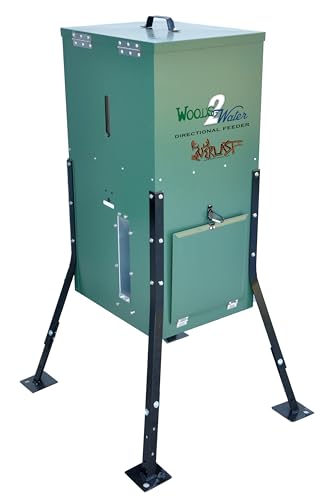
Best for: Large lakes or ponds that require a high-capacity dispensing system with reliable, timed feedings. The 12-volt motor delivers substantial torque for long intervals between refills. The built-in site glass helps monitor feed levels without disassembly.
Why selected: This feeder combines a high-capacity auger with a two-stage digital timer, offering precise scheduling across multiple daily feedings. The directional design helps control feed dispersion to reduce waste.
Caution: Requires access to a power source or robust battery setup; ensure secure mounting to handle wind and potential wildlife interference.
Texas Hunter Directional Feeder DF125DL with Straight Legs
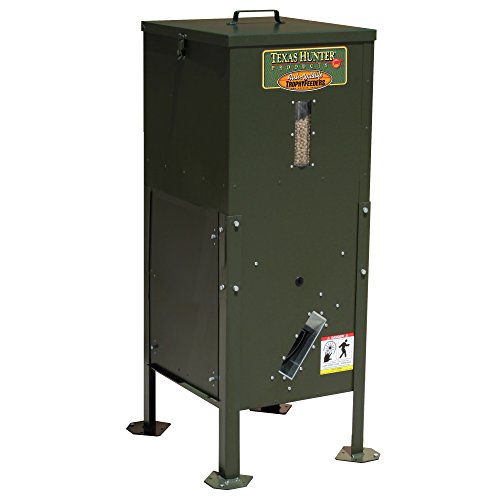
Best for: Ponds with steady access to a power source and a need for a strong wedge-shaped feed pattern. The 70 lb capacity (125 lb corn) and straight-leg design provide solid stability on varied terrain.
Why selected: The unit features a premium digital timer, a 12-volt power system, and a centrifugal air blower that projects feed outward while minimizing drop near the unit. This makes it well-suited for larger water bodies.
Caution: Feeds multiple times per day; ensure the feed pattern covers the intended feeding zone to avoid overdispersion or missed feeding pockets.
Texas Hunter DF125AL Adjustable Legs Feeder

Best for: Lakes or ponds with uneven or soft banks where adjustable support is advantageous. The legs offer stability and leveling options across varied shorelines.
Why selected: Combines 70 lb feed capacity with adjustable legs and foot pads plus a stabilizing stake system. It includes a 12-volt battery and a robust digital timer for flexible scheduling.
Caution: Setup may require more anchoring and ground preparation to prevent tilting, especially in windy or storm-prone environments.
Dehyteco Solar Automatic Feeder for Ponds
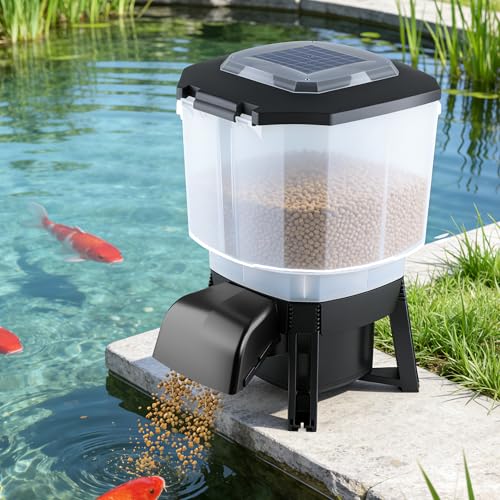
Best for: Remote lake or pond locations with reliable sun exposure and a need for solar-powered operation. It offers a large storage capacity and flexible scheduling.
Why selected: This feeder can run on solar with an internal battery backup, ensuring feeding continuity during power outages or cloudy days. Its programming supports multiple daily feed sessions and portion control.
Caution: Solar performance varies with weather; verify the solar panel orientation and ensure the unit is shaded from excessive debris that could affect operation.
Pond Logic KoiGrower Automatic Pond Feeder

Best for: Koi ponds and larger freshwater installations requiring continuous, scheduled feeding with flexible power options. The 5 gallon feed container supports extended feeding cycles.
Why selected: Multi-modal power supply (solar, AC, battery) ensures reliable operation during vacations or power interruptions. It supports customizable schedules for consistent meal times.
Caution: Capacity is moderate for very large populations; plan refills or additional feeders for bigger koi groups.
Buying Guide: Key Considerations For Lakes And Large Ponds
- Feeder capacity and feed type: Large lake setups benefit from high-capacity models and compatibility with pellets, sinking sticks, or corn. Choose a unit that handles your typical feed size and daily allotment.
- Power options: Solar with battery backup works well in remote lake locations. If the feeder stays near a building or dock, wired 12V or AC power can offer consistent performance.
- Dispersion pattern: Directional or wedge-shaped patterns help minimize wasted feed and water contamination. Confirm the pattern fits your shoreline and fish congregations.
- Durability and weather resistance: Outdoor use requires weatherproof housings, rust-resistant components, and secure mounting to withstand wind and wildlife.
- Programming and ease of use: Look for clear LCD or digital timers, multiple daily feedings, and portability if you rotate feeders around a large lake system.
- Maintenance and refilling: Larger reservoirs reduce refill frequency but require routine cleaning to prevent mold or moisture buildup in the storage bin.
- Installation considerations: Flat, stable mounting surfaces or sturdy legs are important. Ensure safe wiring and avoid areas prone to flooding or splash zones.
Frequently Asked Questions
- What capacity feeder should I choose for a large lake?
– For large lakes, select feeders with 70–125 lb capacities or larger, and consider multiple feeders for even coverage across zones. - Can these feeders operate without constant power?
– Many models offer solar, battery, and AC options to ensure continuous feeding, but performance may vary with cloudy days or low sun. - Which feeder pattern works best for fish dispersed around a shoreline?
– Directional or wedge-type patterns are better for steering feed toward feeding zones and reducing waste near banks. - How often should I program feedings in a lake setting?
– Start with 1–3 feedings per day and adjust based on water quality, fish activity, and observed feeding behavior. - Are there any maintenance tasks to perform regularly?
– Clean the dispenser, check seals for moisture ingress, and inspect mounting hardware and battery connections periodically. - Is it better to use corn or fish feed pellets in lake feeders?
– Use the feed type recommended by the feeder manufacturer and compatible with your fish species; some systems handle pellets better than loose corn, reducing waste.