Answering the question “pond chemicals for weeds,” this guide highlights top options to control submerged and emergent vegetation, floating weeds, and algae. These selections are suitable for different pond sizes, water conditions, and weed types. Best for homeowners with moderate weed growth, best for lake and large pond owners, best for busy or HOA-managed water features, best for shoreline management, and best for general algae and weed control in smaller ponds.
Summary table of selected products:
| Product | Best For | Key Benefit |
|---|---|---|
| Airmax Wipeout Pond Weed Defense | All-season pond owners | Systemic herbicide; controls submerged and floating weeds; long-lasting |
| Tsunami DQ Aquatic Herbicide (Quart) | Wide range of weeds | Fast-acting diquat-based control; broad-spectrum |
| Airmax EasyKlear Pond & Lake Algae & Weed | Bottom-growing algae and submerged weeds | 2-in-1 algaecide and herbicide; easy granular application |
| Airmax Shoreline Defense Emergent Weed Control (Gallon) | Shorelines and emergent weeds | Kills down to the root; surfactant-assisted application |
| Cutrine-Plus Liquid Algaecide | Algae-heavy ponds | Broad algae control; fast-acting |
Airmax Wipeout Pond Weed Defense
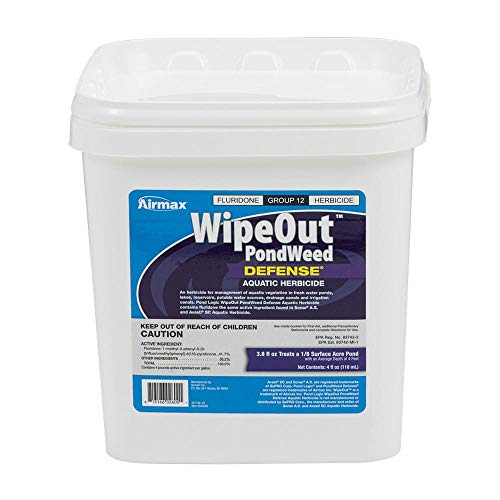
Product overview: This long-term pond weed control uses a systemic floridone herbicide to slow growth of submerged and floating weeds by reducing chlorophyll, effectively starving them of nutrients without rapid oxygen depletion. It treats the entire water body and works across seasons. The formula is designed to be easy to apply—combine with pond water and pour around the pond edge. It’s positioned as a convenient option for busy owners, HOAs, commercial facilities, and golf-course ponds.
Who it’s best for: Ideal for pond owners seeking a single, year-round treatment that reduces weed growth without frequent applications. Best for smaller to mid-sized ponds where extended control is desired without disrupting fish or water quality.
Why chosen: It covers both floating and submerged species—duckweed, water lilies, coontail, hydrilla, elodea, lily pads, and more—offering broad-spectrum impact with a straightforward application method. A noted limitation is that it requires proper mixing and distribution around the edge rather than a quick, spot-treatment approach.
Considerations: Avoid over-application near fish habitats; ensure you follow labeling for water use and irrigation restrictions. Use in seasonal cycles to maintain weed suppression without stressing pond biology.
Tsunami DQ Aquatic Herbicide (Quart)

Product overview: Tsunami DQ uses diquat dibromide to target a broad spectrum of aquatic weeds and algae. It is formulated to deliver fast results, killing submerged, floating, and emerged weeds in ponds and lakes. The product is positioned for rapid, visible impact, helping restore water clarity and usability in shorter timeframes than some slower-acting options.
Who it’s best for: Suitable for pond owners dealing with multiple weed forms and those needing swift weed reduction, such as before events or peak-use periods. It’s also a fit for larger water bodies where faster knockdown is a priority.
Why chosen: The fast-acting formula helps manage weed burdens quickly, making it a good countermeasure during heavy growth periods. A limitation is that diquat-based products often require careful handling and adherence to state-specific restrictions, so verify applicability in your area before use.
Considerations: Use as directed, avoid treating in adverse weather, and be mindful of local regulatory restrictions on diquat-based products. Best used as part of an integrated weed management plan rather than a sole solution for persistent beds.
Airmax EasyKlear Pond & Lake Algae & Weed

Product overview: EasyKlear is a 2-in-1 granular treatment that acts as both an algaecide and a herbicide. It targets bottom-growing algae, Chara, and submerged weeds, delivering long-lasting results with a simple granular application that sinks to the target layer. No mixing or measuring is required, making it a practical option for quick deployments.
Who it’s best for: Choose this if you want a single, straightforward granular product that handles both algae and weeds, particularly in ponds with prominent bottom-growth and submerged plants. It’s well-suited for larger ponds where a spreader can evenly apply granules.
Why chosen: The 2-in-1 approach provides versatility and reduces the number of products needed. A potential limitation is the requirement for a spreader and the need to wait for granules to reach their target depths, which may delay visible results in shallow, highly mixed waters.
Considerations: Ensure even coverage by the spreader and monitor for any non-target impacts on beneficial aquatic vegetation. Use as part of a routine maintenance plan to sustain clear water longer between treatments.
Airmax Shoreline Defense Emergent Weed Control (Gallon)

Product overview: This concentrated glyphosate-based aquatic herbicide is designed for emergent weeds along shorelines, grasses, cattails, and brackish water use. The product aims to kill weeds down to the root, helping reclaim beaches, docks, and shorelines. Surfactant assistance improves uptake, contributing to long-term control when applied correctly.
Who it’s best for: Ideal for shoreline management and emergent weed problems around ponds, lakes, and coastal-influenced water. Choose this when shorelines are overtaken by persistent emergent vegetation that requires root-zone treatment.
Why chosen: It addresses root systems for lasting suppression, reducing re-sprouting. A caution is that proper surfactant use and application technique are important for effective uptake, so follow label directions closely and test in a small area first.
Considerations: Use near waterfowl habitats with care, and avoid over-application near vegetation you want to preserve. This product is best used as part of a shoreline maintenance plan rather than a sole solution to underwater weed problems.
Airmax Shoreline Defense Emergent Weed Control (Quart)

Product overview: Similar to the gallon version, this quart concentrate targets emergent weeds with glyphosate-based action. It provides a practical middle-ground option for smaller shoreline areas or when a lighter treatment is preferred.
Who it’s best for: Suitable for smaller shoreline projects or where a more compact container is desirable for limited application scopes. It’s a fit for property owners dealing with cattails or other marginal weeds near docks or beaches.
Why chosen: The product’s emphasis on root-killing capability supports long-term shoreline management. A limitation is that quart-sized applications may be insufficient for larger shorelines without multiple treatments or a larger-volume product.
Considerations: Follow surfactant guidance and adjust volumes for waterbody size. Plan for repeated applications if emergent weeds persist along the shorelines.
Cutrine-Plus Liquid Algaecide
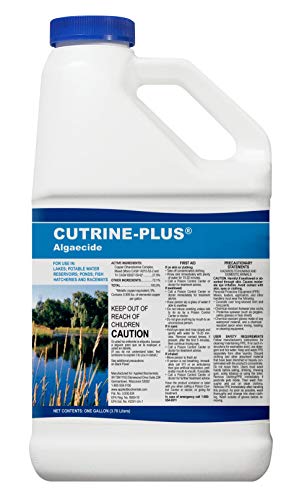
Product overview: Cutrine-Plus is an EPA-approved copper-based algaecide designed to target major algae types, including planktonic, filamentous, and Chara. It is positioned as a fast-acting solution for water clarity, suitable for ponds, lakes, hatcheries, and irrigation systems. The formulation emphasizes rapid reductions in algae growth with a focus on water clarity and balance.
Who it’s best for: Best for ponds with heavy algae blooms where a fast-acting algaecide is needed, particularly when algae dominate the water column and impact visual clarity and usability.
Why chosen: It provides broad algae control with a track record of use in professional settings and water-management scenarios. A caution is that copper-based products require caution around copper-sensitive fish species, and certain uses may be restricted by local regulations.
Considerations: Use according to label directions, avoid copper-sensitive species, and consider rotating with other modes of weed control to minimize resistance or stress on aquatic ecosystems.
Buying Guide: Key Considerations For Pond Weed Control
What weed type dominates your pond? Submerged weeds like hydrilla or elodea respond to systemic herbicides, while emergent plants like cattails respond better to shoreline-focused herbicides. For algae, select products labeled for algaecide action in addition to weed control if both forms of growth are present.
Is your pond size and usage a factor? Large ponds or HOA projects may benefit from all-season treatments and higher-volume products. Smaller backyard ponds may do well with simpler, easy-to-apply formulas that reduce maintenance time.
Do you need quick results or long-term suppression? Diquat-based products often provide rapid knockdown, while systemic herbicides and root-killing formulations may deliver slower, more sustained control. Consider a combination approach if weeds recur seasonally.
What are local regulations and water-use restrictions? Some chemicals require permits or have usage restrictions in certain states or water bodies. Always verify state approvals and follow label instructions to protect wildlife and water quality.
What application method fits your routine? Granular formulations provide easy, spreader-based application for large areas, while liquids and concentrates work best for targeted or shoreline treatment. Surfactants can enhance uptake for emergent weeds.
Maintenance and rotation: Avoid relying on a single product year-round. Rotate chemistries to minimize resistance risks and to preserve beneficial organisms. Combine chemical treatments with physical controls (manual removal, shading) where practical.
Frequently Asked Questions
- What should I use first for a pond with both duckweed and submerged weeds? Consider a broad-spectrum herbicide or a 2-in-1 product that targets both floating and submerged weeds, followed by a maintenance plan to prevent recurrence.
- Are these products safe for fish? Most products are designed to minimize harm to fish when used as directed, but some herbicides and algaecides can affect certain species. Always read the label for fish safety and applicable restrictions.
- How often can I apply these treatments? Application frequency depends on the product and weed pressure. Follow the label’s guidance and consider seasonal cycles to maintain water clarity without over-treatment.
- Can I treat algae and weeds at the same time? Yes, many products combine algaecide and herbicide actions. For persistent blooms, a targeted algaecide followed by a weed control product can be effective.
- Do these products require additional equipment? Some products are granular and require a spreader, while others come ready-to-max with mixing and spraying equipment. Choose based on your pond size and setup.
- Are these safe for agricultural use near ponds? Some products have restrictions related to irrigation or nearby crops. Check local regulations and product labels before any use near agricultural sites.