Finding the right pine needle rake tractor attachment helps you clean large lawns fast and protect your soil. This guide highlights five reliable options suited for different tractors and yard sizes. Best for: large estates, those who want fast cleanup with minimal manual effort, and homeowners who prioritize durability and easy maintenance. The top picks cover 60- and 72-inch working widths, cat 0/1/3 compatibility, and robust powder-coated steel tines. A quick comparison table is included to help you choose at a glance.
| Product | Best For | Key Benefit | Limitations |
|---|---|---|---|
| Hipicute 72 Inch 3 Point Tractor Rake | Large yards; Cat 0/1 tractors | Wide working width; durable spring tines | May require adapter for some models |
| Garvee 72 Inch 3 Point Tractor Rake | Kubota, Massey, New Holland users | Top bolt and latch design; powder-coated | Heavier; may stress lighter tractors |
| VEVOR Tow Behind Landscape Rake 72″ | Large properties; Cat 1/3 hitch | Tow-behind design for easy use | Requires compatible hitch and tow setup |
| Field Tuff 60 Inch Steel Spring Coil | Mid-size yards | Wide width; simple attachment | 60″ may be slower than 72″ models on very large areas |
| YITAMOTOR 60 Inch Tow Behind Dethatcher | Heavy debris; large lawns | 24 tines; replaceable; 60″ width | Tow-behind setup requires space to maneuver |
Hipicute 72 Inch 3 Point Tractor Rake

Best for: large lawns and yards with pine straw or needles. Features a 72″ working width and 32 spring steel tines, designed for Cat 0 and Cat 1 tractors. The powder-coated steel helps resist weathering and wear. Best used for pine straw, needles, leaves, and other yard debris, enabling quick cleanup across expansive areas.
Caution: Ensure your tractor can handle a 72″ implement; check hitch compatibility and weight balance to prevent strain on the three-point hitch.
Garvee 72 Inch 3 Point Tractor Rake
Best for: Kubota, Massey, and New Holland owners seeking a stout pine straw rake. It features a top bolt and ring latch, with powder-coated durability for long-term use. The 72″ width helps cover more ground and reduces cleanup time, especially on larger properties.
Limitation: The design emphasizes durability; lighter tractors should verify payload capacity before use to avoid hitch stress.
VEVOR Tow Behind Landscape Rake 72″
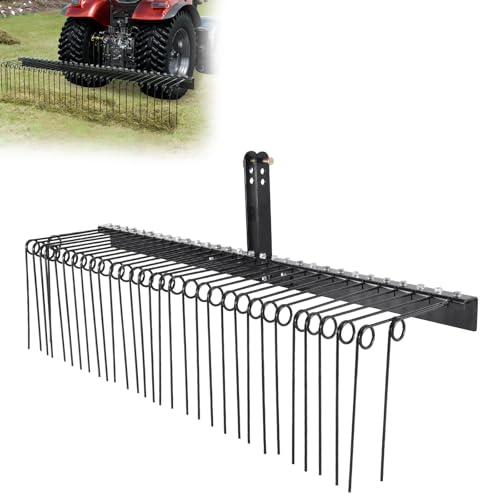
Best for: large yards requiring efficient tow-behind operation. With 32 steel tines and compatibility with Category 1 and 3-point hitches, this rake increases cleaning efficiency for pine needles, leaves, and straw. The 72″ width helps cover big areas on one pass.
Limitation: Tow-behind rakes need ample space for turning maneuvers and proper hitch alignment to avoid swerving.
Field Tuff Steel Spring Coil 60 Inch

Best for: mid-size properties where a balance of width and maneuverability is needed. Features a 60″ working width with 32 spring steel tines for reliable performance, leaving a tidy lawn finish with efficient debris pickup.
Limitation: The 60″ width is slower than 72″ models on very large lawns, potentially increasing cleanup time for expansive properties.
YITAMOTOR 60 Inch Tow Behind Dethatcher

Best for: extensive lawns needing thorough dethatching with robust tines. The 24 spring steel tines are replaceable, and the 60″ width provides efficient coverage. Powder-coated frame offers rust protection for long-term outdoor use.
Limitation: Tow-behind configuration requires a stable tow point and adequate clearance to avoid debris kickback or hitch misalignment.
Buying Guide
What size should I choose?
Consider lawn area and tractor capacity. A 72″ rake covers more ground per pass and is ideal for large yards, while 60″ models offer easier maneuverability on mid-size properties.
What hitch compatibility matters?
Verify Cat 0, Cat 1, or Cat 3 compatibility. Three-point hitches are common with tractor attachments, but some models are tow-behind, requiring space to operate safely.
Are tines important?
32 spring steel tines provide durability and effective debris collection. Replaceable or coil-tine designs help minimize maintenance downtime and prolong tool life.
What about durability and finish?
Powder-coated frames resist rust and weathering, extending service life in outdoor conditions. Look for solid latches and robust construction to support heavy pine straw and leaves.
Maintenance tips
- Regularly inspect tines for bending or wear; replace as needed.
- Lubricate hitch points and bolts to maintain smooth operation.
- Clean debris after use to prevent rusting on metal surfaces.
Selecting by use case
For very large properties, a 72″ tow-behind or three-point rake can save significant time. For frequent small-cleanup tasks, a 60″ model with easy attachment may be preferable.
Frequently Asked Questions
- What is the benefit of a 3-point tractor rake over a tow-behind rake?
3-point rakes attach directly to the tractor hitch, offering stable control and consistent depth, while tow-behind rakes are easier to maneuver on wide tracks. - Can these rakes handle pine needles only?
Most models are designed to handle needles, straw, leaves, and light debris, though performance varies with density. - Do these require special maintenance?
Basic maintenance includes checking tines, hitch hardware, and applying rust protection where needed. - Which is best for heavy yard debris?
Rakes with more tines and a stronger frame, such as 32-tine spring designs, are better for heavier cleanup. - Are these compatible with all tractors?
Compatibility depends on hitch type (Cat 0/1/3) and mounting arrangement; always verify your model’s specs. - Is a 60″ rake enough for large properties?
It can be efficient for mid-size yards, but very large lawns may benefit from a 72″ model to reduce passes.