Answer: Heated snow melting mats provide automatic, energy-efficient snow and ice removal for driveways, sidewalks, and steps. They’re best for homeowners needing hands-off winter maintenance, small business owners with outdoor entryways, and anyone seeking slip-free, shovel-free surfaces. This guide highlights five top mats and explains which is best for your space, installation needs, and climate.
Summary of selected products:
| Product | Best For | Coverage | Installation Type |
|---|---|---|---|
| SNOWMELTZ Heated Driveway System | Full driveway and entryways | 2′ x 65′ (approx. 130 ft2) | Under concrete/asphalt/pavers |
| funomo 4 Pack 10×30 Mats | Modular, small-to-medium layouts | Total 120 ft2 (4 x 10×30) | Lay-out with cords |
| WarmlyYours 2×50 ft PowerMat | Long runways and scattered areas | 100 ft2 (2×50 ft) | Under surface inlays |
| HeatTrak 30×60 Mat | Walkways and decks | 30″ x 60″ | Standalone mat |
| SNOWMELTZ Large Area System | Large driveways and multiple zones | Total 300 ft2 (4 mats) | Under surface |
SNOWMELTZ Heated Driveway System 130 Sqft

Best for: homeowners needing comprehensive coverage for a driveway plus adjacent sidewalks and steps. This system delivers 37 watts per square foot at 240 volts with an activator for automatic moisture and temperature sensing.
- Features: 2′ wide by ~65′ long mat, automatic activation via sensors, energy-conscious operation to maintain slip-free surfaces.
- Why chosen: Offers substantial 130 ft2 of coverage with automated control, suitable for retrofit projects and new installations.
- Limitation: Large outdoor areas require careful planning for wiring and protection from the elements.
SNOWMELTZ Large Area System

Best for: large driveways and multi-zone areas that require even heating across extensive stretches. The system uses four mats to cover up to 300 ft2 with automatic sensor activation.
- Features: High-efficiency heating at 37 watts per ft2, sensor-activated, adaptable to concrete, asphalt, or pavers.
- Why chosen: Superior coverage makes it ideal for bigger properties and commercial-lite applications.
- Limitation: More complex installation due to multiple mats and connections.
WarmlyYours 2×50 ft PowerMat
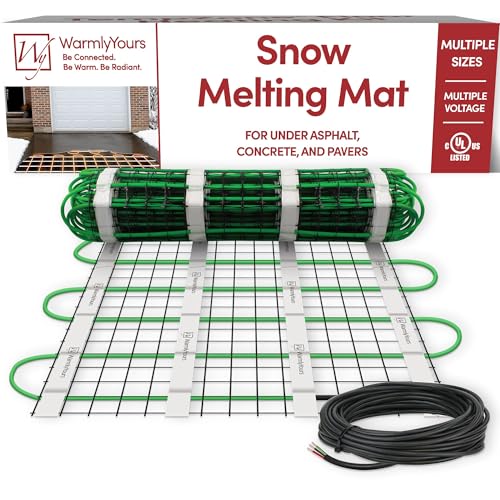
Best for: longer linear applications such as a wide driveway or extended walkways. This 2×50 ft mat sports embedded heating with a focus on invisible integration under asphalt, concrete, or pavers.
- Features: Embedded design for near-invisible installation, CSA certified, robust under heavy foot and vehicle traffic.
- Why chosen: Strong option for long runs with steady, reliable heat delivery.
- Limitation: Requires precise in-surface placement; installation is more involved than standalone mats.
HeatTrak Heated Snow Melting Mats

Best for: walkways and decks where sturdy, seasonal coverage is important. HeatTrak emphasizes a durable build and easy installation for winter-ready paths.
- Features: Durable, easy to install, energy efficient with heat output around 2 inches per hour; mat reaches 40°F above ambient and works down to -8°F.
- Why chosen: A balance of reliability and simplicity for mid-sized outdoor paths.
- Limitation: Larger or more complex layouts may require multiple mats and careful wiring planning.
NexiPro Snow Melting Mats (4-Pack)

Best for: modular setups where users want to create a custom layout across walkways and decks. The four mats can be joined to suit different shapes and lengths.
- Features: Anti-slip rubber, efficient at melting up to 2 inches of snow per hour, durable, and designed for interconnection in a larger system.
- Why chosen: Flexibility to tailor a snow-melt system to irregular spaces.
- Limitation: Interconnecting mats may require additional wiring planning and protective measures.
Buying Guide: Key Considerations
- Coverage needs: Measure driveways and walkways to determine total square footage and choose mats that fit your layout with minimal cutting.
- Power supply: Check voltage requirements (commonly 120V or 240V) and whether your electrical panel can support the load for the planned area.
- Automation: Look for sensor-activated mats that respond to moisture and temperature for hands-off operation.
- Installation surface: Decide if mats will be installed under concrete, asphalt, or pavers. Some systems require in-surface embedding; others are surface-laid with cords and protectors.
- Durability: Choose mats with weatherproof housings and non-slip surfaces for winter conditions and heavy traffic.
- Maintenance: Prefer products with clear instructions for periodic checks and simple repairs to wiring or seals.
- Safety and compliance: Verify CSA or equivalent certifications when available for outdoor use and electrical safety.
FAQ
- What is the typical heating output for these mats?
Most systems provide around 37 watts per square foot at 240V for efficient snow melting, with variants at different layouts.
- Can these mats be installed under any outdoor surface?
Many mats are designed for installation under concrete, asphalt, or pavers, but some models are meant to be laid on the surface or integrated in specific configurations.
- Do I need a professional to install these mats?
Complex layouts and high-power systems may benefit from professional electrical and concrete work, especially for safety and code compliance.
- How automatic are these systems?
Most units feature moisture and temperature sensors that trigger heating when needed, reducing energy use and avoiding manual operation.
- Are these mats safe for pets and children?
Well-installed mats with proper protection and safety certifications reduce slip hazards and are designed for outdoor use in winter conditions.
- Can I combine multiple mats for larger areas?
Yes, several products support interconnection to create a custom layout for larger driveways or multiple zones.