The best LED grow light for a 2×4 tent combines strong canopy coverage, full-spectrum output, and user-friendly controls. This guide highlights five top choices, explaining who each is best for and why. Ideal buyers include hobbyists upgrading from fluorescent systems, small-commercial setups, and growers seeking energy efficiency with reliable daisy-chain capabilities. The table below compares key features to help you choose quickly.
| Product | Best For | Key Benefit |
|---|---|---|
| Spider Farmer G4500 | Budget-conscious grows with edge-to-edge coverage | Uniform canopy and high PPE |
| TheOneGrow MA2000 | Energy-efficient growers prioritizing yield | 200W with up to 30% yield boost |
| AC Infinity IONFRAME EVO3 | Smarter setups with app control | Schedule control and deep canopy with wide coverage |
| Spider Farmer SE4500 | Smart control users and precise spectrum needs | Advanced app control and tuned spectrum |
| VIPARSPECTRA XS3000 Pro | Commercial-style multi-light setups | Lens-based uniform PPFD and daisy chaining |
Spider Farmer G4500 Cost-Effective 320W LED Grow Light

The G4500 uses a long bar design to deliver uniform coverage across 2×4 ft tents and up to 3×5 ft areas. With Bridgelux diodes and a maximum 320W draw, it achieves about 2.85 µmol/J PPE. This model is best for growers who want strong edge-to-edge penetration and a simple dimming control for 10–100% brightness. A handy daisy-chain function supports linking up to 50 units for synchronized dimming, which is ideal for mid-sized tent operations. Consider this if you want reliable full-cycle growth with minimal hotspot risk. Limitation: 320W may be overkill for very small tents or seedling-only setups.
Who this is for: Enthusiasts and hobbyists seeking consistent full-cycle performance in a 2×4 tent or a compact 3×5 footprint, with scalable multi-light setups.
TheOneGrow MA2000 LED Grow Lights

The MA2000 replaces traditional 400W HID with a compact 200W draw while offering up to a 30% yield increase. Its true full-spectrum mix (660nm red, 3000K warm white, 5000K cool white, 730–740nm far-red) supports all growth stages from seed to harvest. Dimming and daisy-chain capabilities simplify scale-up in larger tents and racks. The included hanging kit eases installation. Choose this model if energy efficiency is a top priority and you want consistent, daylight-like spectrum for herbs, leafy greens, and ornamentals. Caution: check if your setup requires higher PPFD for flowering-heavy crops.
AC Infinity IONFRAME EVO3 2×4 LED Grow Light

The EVO3 uses Samsung LM301H EVO diodes, delivering high efficiency with up to 3.14 µmol/J PPE. The bar-style fixture supports even coverage and deep canopy penetration. It includes a schedule controller and WiFi-enabled UIS platform compatibility for app control, making it well-suited for growers who want automated timing and remote adjustments. Best for professional or semi-professional setups that value precise control and uniformity. Limitation: higher upfront cost relative to basic fixtures.
Spider Farmer SE4500 320W LED Grow Light
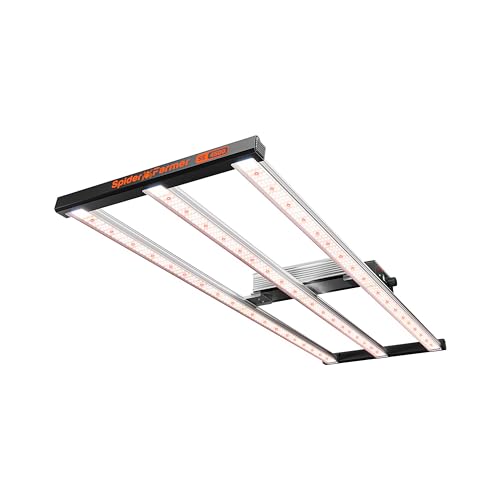
The SE4500 emphasizes a tuned full spectrum with Bridgelux diodes and an extended 3-bar design for uniform edge-to-edge coverage in 2×4 ft layouts. Efficacy runs around 3.14 μmol/J, delivering strong photon output (913 μmol/s) at 320W. The Spider Farmer App provides scheduling, sunrise/sunset simulations, and remote brightness control, making it easier to optimize plant cycles remotely. Best for growers who want precise spectrum tuning and smart control. Limitation: some users may prefer additional wattage for very high-PPFD crops.
VIPARSPECTRA XS3000 Pro Grow Light

The XS3000 Pro features optical lenses to concentrate light for uniform PPFD across all corners, which helps maximize photosynthesis in dense canopies. It supports up to 20-light daisy chaining for large-scale setups and provides a full-spectrum mix (white 3000K, 5000K, red 660nm, IR 730nm). This makes it a strong choice for grow tents that scale to commercial-style configurations. Best for multi-light environments and growers seeking precise light distribution. Caution: more complex wiring and dimming control may require careful installation in smaller tents.
Buying Guide: Key Considerations For 2×4 Tent Grow Lights
Size and footprint: Ensure the fixture provides even coverage across a 2×4 ft area without hotspots. Look for bar-style or multi-bar designs that cover the edges well.
PPF and PPFD: High photosynthetic photon flux (PPF) and uniform PPFD across the canopy support robust yields. Compare PPE (µmol/J) to gauge efficiency.
Spectrum: A true full-spectrum setup with blue (around 440–470 nm), red (660–665 nm), warm white (2700–3500K), cool white (5000–6500K), and optional far-red (730–740 nm) supports all growth stages.
Control features: Dimming, daisy-chain capabilities, and app or schedule control help automate growth cycles and scale with additional units.
Durability and heat management: Look for solid build quality and adequate heat sinking to maintain performance over time in a tent environment.
Installation and wiring: Consider included hanging kits, mounting options, and whether daisy-chaining requires a separate power setup.
Frequently Asked Questions
- What size LED light is best for a 2×4 tent? A light in the 200–320W range with uniform edge-to-edge coverage is typically suitable for a 2×4 tent, depending on desired PPFD levels.
- Is full-spectrum essential for all stages? A true full spectrum supports seedling, vegetative, and flowering stages in one setup, reducing the need for separate lights.
- What is daisy chaining good for? It allows syncing multiple fixtures for uniform brightness and simplifies wiring in larger configurations.
- Do LEDs consume a lot of power? Many high-efficiency models deliver strong yields at 200–320W total draw, making them energy-efficient options for tents.
- Should I choose app-controlled lights? App control helps with scheduling and remote management, which is beneficial for busy growers or remote setups.
- Are lens-focused lights better? Lenses can improve uniformity and PPFD at the canopy edges, useful for larger tents or dense canopies.