Answering your search for a grow box with carbon filtration starts with selecting a kit that reliably removes odors while delivering solid airflow. This guide showcases five top options ideal for different setups, from compact tents to larger grow boxes. Each pick targets odor control, airflow, and ease of use, so you can pick the best fit for your space. The buyer types below indicate who benefits most from each product.
| Product | Best For | Key Benefit |
|---|---|---|
| MELONFARM Air Filtration Kit, 4″ Inline Duct Fan | Small to medium tents | High odor control with robust 190 CFM airflow |
| MELONFARM Air Filtration Kit, Built-in 14cm Fan | Quiet, compact setups | Integrated fan with multiple speeds for steady air movement |
| VIVOSUN 4 Inch Air Carbon Filter | Versatile indoor spaces | Strong odor removal with high filtration rate |
| ATOUR 4 Inch Carbon Filter + Built-in Fan | All-in-one solutions | Integrated power and odor control with decent airflow |
| AC Infinity 6″ Air Carbon Filter | Larger tents or rooms | Premium charcoal for extended life and strong odor control |
Each product below is described with clear, buyer-focused details, including who it’s best for, why it was selected, and a practical caveat where relevant. Compare features side by side to determine the best fit for your grow box and odor-control needs.
MELONFARM 4″ Inline Duct Kit With 190 CFM Fan
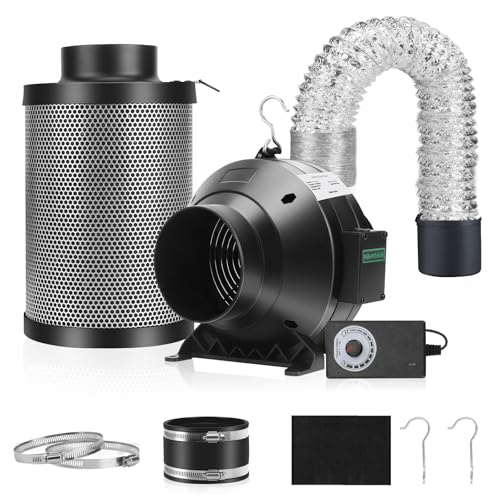
Best for compact grow boxes and grow tents where robust odor control is essential. This kit pairs a 4″ carbon filter with a high-flow inline duct fan delivering up to 190 CFM at 2300 RPM. The included 8 ft ducting and rubber coupler simplify setup, while the durable flange and base help prevent carbon leakage. Ideal for eliminating smells in small to medium spaces and for transfer heat or fresh-air circulation. Caution: high airflow can cause stronger noise depending on mounting and duct length.
MELONFARM 4″ Filtration Kit With 14cm Built-In Fan

Best for quiet operation in small spaces where discreteness matters. This kit features a built-in 14 cm fan with a 12-speed controller and a 4″ x 12.6″ carbon filter. The double-sided galvanized steel mesh design maximizes airflow while keeping odor control consistent. It’s well-suited for indoor gardens and hydroponics setups that require steady, low-noise performance. Caution: larger units may be overkill for ultra-tight tent spaces.
VIVOSUN 4 Inch Air Carbon Filter With 12″ Canister

Best for flexible setups needing a straightforward odor-control solution. The VIVOSUN filter uses premium Australian virgin charcoal with an IAV around 1200+ for strong adsorption. A longer canister and a detachable pre-filter improve filtration efficiency and ease of cleaning. Suitable for indoor grow tents, hydroponics rooms, or kitchens. Caution: performance depends on compatible duct sizing and airflow path.
ATOUR 4″ Carbon Filter With Built-In 5.5″ Fan

Best for all-in-one convenience where space is limited. This 4″ carbon filter pairs with a built-in 5.5″ quiet fan and includes a pre-filter, vent cover, and 4″x13.4″ dimensions. It uses Australian virgin charcoal (IAV 1200+) for robust odor control and features a deflector to minimize turbulence. Choose this if you want a compact, ready-to-use filter-and-fan solution. Caution: built-in fan may limit airflow compared to standalone fans in larger rooms.
AC Infinity 6″ Premium Carbon Filter

Best for larger grow boxes or rooms with demanding odor-control needs. The 6″ inline filter uses premium Australian virgin charcoal for extended life and high adsorption capacity, paired with a corrosion-resistant powder-coated finish. It’s designed to block odors effectively while supporting higher-volume airflow. Caution: heavier unit may require sturdier mounting and larger ducting for optimal performance.
Buying Guide: Key Considerations for Grow Boxes With Carbon Filters
- Size and airflow: Match the filter size (in inches) to your ducting and tent dimensions. Higher CFM supports larger spaces and faster odor removal but may require more powerful fans.
- Charcoal quality: Look for RC 412 Australian virgin charcoal or equivalent with an IAV around 1200+ for strong adsorption and longer life.
- Filtration vs. overall flow: Choose a setup that balances odor control with adequate airflow to prevent heat buildup and humidity.
- Build quality: Durable flanges and pre-filters help prevent leaks and keep filters clean, extending service life.
- Noise level: Integrated fans are convenient but noisier; consider built-in fans or deflectors to minimize sound in quieter spaces.
- Maintenance: Detachable pre-filters and accessible canisters simplify cleaning and replacement schedules.
- Installation: Ensure compatibility with existing tent sizes, ducting length, and mounting support in your space.
Frequently Asked Questions
- What is a carbon filter and why is it essential for a grow box?
A carbon filter uses activated charcoal to adsorb odors and volatile compounds, keeping indoor spaces discreet and preventing odor from escaping the grow area. - How do I choose the right filter size?
Base the size on your duct diameter and the room or tent volume. Larger spaces typically need 6″ or 4″ filters with higher CFMs to maintain airflow and odor control. - Can I use any fan with a carbon filter?
Most 4″ or 6″ filters pair best with matching-sized inline duct fans for optimal performance. Always verify compatibility with the filter’s flange size and airflow ratings. - Is built-in fan filtration better than separate components?
Built-in options save space and simplify setup but might offer less airflow versatility. Separate components can provide more flexible airflow control in larger setups. - How often should carbon filters be replaced?
Replacement depends on usage, air quality, and maintenance. Signs of reduced odor control or visible clogging indicate it may be time to replace the filter.