The best dye markers for weed spraying provide a visible, temporary color to indicate where products have been applied, helping you avoid over-application and missed areas. This guide focuses on water-based spray indicators that work with common lawn care solutions. It’s ideal for homeowners and lawn-care professionals who want precise coverage, faster cleanup, and easier record-keeping for treatment areas.
Who should consider these products? Homeowners managing medium to large yards will benefit from clear visual markers for spray accuracy. Lawn care professionals require reliable, fast-drying dyes for efficient job completion. If you use water-based herbicides, pesticides, or fertilizers, the markers listed here are designed to mix with your solutions and leave a temporary, non-staining blue or green trace that fades with time.
Summary table of select products
| Product | Best For | Key Benefit | Notes |
|---|---|---|---|
| Liquid Harvest Lazer Blue (32 oz) | Large lawns, frequent treatments | Row-spray coverage indicator; mixes with water-based solutions | Blue color fades as it dries; easy visual confirmation |
| Adios! Blue Spray Dye Marker (8 oz) | Budget-conscious or smaller applications | High-concentration; up to 16 gallons per bottle | Blue fades in 24–48 hours |
| Liquid Harvest Lazer Blue (8 oz) | Spot treatments and precision work | Drift detection; prevents over-application | Simple to add to sprayer |
| Liquid Harvest Lazer Green (8 oz) | Color preference for visibility | Visual spray coverage with drift prevention | Clear, temporary color |
| Blue Spray Marker (8 oz) | General lawn spraying with clear marking | Non-staining, easy-to-see blue dye | Light non-permanent coloring |
Liquid Harvest Lazer Blue – 32 Oz
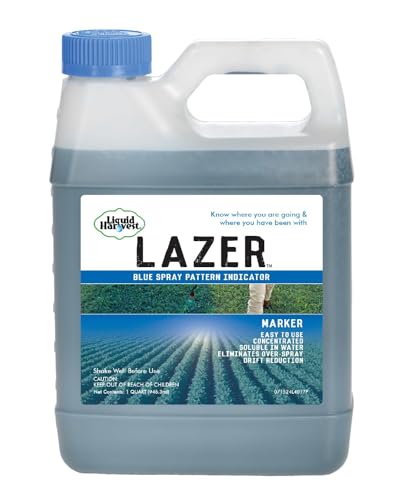
Product overview: This concentrated spray pattern indicator mixes with water-based solutions, not oil-based ones, and easily marks grass and lawns. It can be mixed with herbicides, fungicides, pesticides, and fertilizers to provide a visible guide during applications.
Best for: Large lawns and frequent treatments where a strong, long-lasting visual marker is helpful. It’s suited for users who need a reliable blue indicator that integrates smoothly with standard lawn care chemicals.
Why it’s selected: The concentrated dye helps prevent overlapping applications and ensures coverage portions are clearly visible. It supports efficient workflow by making treated areas obvious at a glance.
Limitation: It will not work with oil-based solutions, and the dye may require thorough rinsing off non-lawn surfaces to avoid staining.
Adios! Professional Blue Spray Dye Marker, (8oz)

Product overview: A super-concentrated dye designed to create up to 16 gallons of indicator by mixing 1/2 oz per gallon. It provides a bright royal blue that’s easy to see on lawns and fades within 24–48 hours.
Best for: Professionals and homeowners who want maximum visibility with minimal product use per application. Ideal when you need to mark precise spray areas for single-treatment tasks.
Why it’s selected: The high concentration reduces the number of containers needed for larger projects and helps prevent over-application by clearly showing treated zones.
Limitation: The blue color fades relatively quickly, so timing matters for subsequent treatments or color-coding across multiple days. Use where quick fading is acceptable.
Liquid Harvest Lazer Blue Concentrated (8 oz)

Product overview: An 8-ounce concentrate designed to mix with water-based solutions for easy turf marking. It helps prevent over-application and supports detecting spray drift.
Best for: Homeowners with smaller properties or projects where a compact bottle is more convenient. Great for localized treatments and spot checks.
Why it’s selected: It emphasizes accurate application by visually indicating where coverage occurs, reducing waste and enhancing efficiency.
Limitation: As a smaller bottle, it may require more frequent reordering for large yards or multiple treatments.
Liquid Harvest Lazer Green Concentrated Spray Pattern Indicator (8 oz)

Product overview: This green version mirrors the Lazer Blue in functionality but uses a different color for users who prefer green for spray indicators. It’s designed to prevent over-application and detect drift when added to your sprayer.
Best for: Gardeners who prefer green markers or need color differentiation when using multiple products in the same yard. Good for multi-step programs where color coding is helpful.
Why it’s selected: The same practical benefits as the blue variant—clear visual cues and drift detection—while offering a color option to match user preference.
Limitation: Like other dyes, it is temporary and susceptible to weathering; ensure you apply within intended windows for precise outcomes.
Liquid Harvest Lazer Blue Concentrated 1 Gallon (128 oz)

Product overview: A one-gallon bottle of blue spray pattern indicator that mixes only with water-based solutions. It marks grass clearly and is compatible with herbicides, fungicides, pesticides, and fertilizers.
Best for: Large properties or professional crews needing longer-lasting dye coverage per bottle. It’s efficient for extensive spraying programs.
Why it’s selected: The higher volume lowers the frequency of reorders and supports consistent coverage checks over big areas.
Limitation: Heavy bottle may be less convenient for quick jobs or tight spaces; plan storage and usage accordingly.
Buying Guide: How To Choose The Right Dye Marker
What factors matter most when selecting a dye marker for weed spraying?
- Solution compatibility: Ensure the dye works with water-based solutions and is not designed for oil-based products.
- Color preference and visibility: Choose a color that contrasts with your turf and is easy to see during application but fades reasonably afterward.
- Volume and application rate: Larger bottles reduce refills for big yards; consider whether you’ll spray entire zones or perform spot treatments.
- Drying time and fading: Short fade times help when multiple passes are needed, but ensure the marker remains visible long enough for your workflow.
- Drift prevention and accuracy: Markers that aid in detecting spray drift help minimize waste and protect non-target areas.
- Ease of use: Simple mixing instructions and compatibility with existing sprayers save time and reduce mistakes.
- Non-staining and surface impact: The dye should be non-permanent on turf and non-staining on non-target surfaces with proper usage.
Practical usage tips
- Mix according to product instructions and add directly to the spray tank before loading the solution.
- Conduct a small test area to confirm visibility and fading behavior before full-scale application.
- Mark treated areas in a consistent pattern to improve coverage checks and future planning.
FAQ
- Q: Can I use dye markers on all lawn types? A: Most markers are designed for typical turf but avoid using on delicate or newly reseeded areas until the turf establishes.
- Q: Do these dyes stain sidewalks or driveways? A: They are intended to be temporary and water-soluble, but test on a small area first and rinse promptly to minimize transfer.
- Q: Will dye markers affect plant safety? A: Markers are meant to be spray indicators; they do not alter the effectiveness of the herbicides or fertilizers when used as directed.
- Q: How long does the color last after application? A: Fade times vary by product, typically ranging from 24 hours to a few days, depending on sunlight and weather.
- Q: Can I reuse leftover dye in my next treatment? A: Reuse depends on storage and product guidelines; follow manufacturer instructions for best results.
- Q: Are green markers better than blue ones? A: It depends on your preference and contrast with the lawn. Both colors serve the same marking purpose and fade similarly.