For hobbyists and small-scale growers, a still air box (SAB) is a reliable tool to minimize contamination during mushroom cultivation. The following selections emphasize clear visibility, durable construction, and practical features that support inoculation, culture work, and bag-based grows. Each product is evaluated on space, ease of use, and adaptability to common mycology tasks, from agar work to bulk grow bags. This guide helps you compare options and choose a SAB that fits your space and skill level.
| Product | Key Benefit | Ideal For |
|---|---|---|
| Salcod Large Still Air Box | Spacious, clear observation, durable materials | Multiple grow bags, observation logs |
| Bella Bora Still Air Box | Higher visibility, improved arm flexibility, US patent-backed | Agar work, inoculations, spore handling |
| ACover Large Still Air Box | New upgraded design, dual side doors, sterile workflow | Sterile cultivation, easy cleaning |
| amymark Still Air Box | Folding/pop-up design, versatile growth setup | Home kits, portability |
| Ehaijia Large Still Air Box | Includes lights for 360° illumination, ready-to-use kit | Indoor mushroom kits with lighting |
Salcod Large Still Air Box Mushroom Grow Tent

The Salcod still air box provides a clear observation area with durable, transparent plastic designed to resist water, scratches, and wrinkles. Its high-elasticity armholes support users of different builds, enabling comfortable, seal-tight operation during inoculation or transfers. The design prioritizes contaminant containment to improve growth success and yield for mushrooms and other hydroponic plants. A spacious interior at 38x20x25 inches accommodates multiple grow bags, while dual-zipper entrances on both sides offer flexible loading and workflow. This SAB suits mushroom growers with mid-sized setups seeking straightforward, reliable operation.
Key considerations for this model include the spacious interior that supports concurrent tasks and the clear walls that aid documentation of growth stages. The absence of attached gloves requires the user to wear disposable gloves for maintenance, which can support a cleanroom-style workflow. Overall, Salcod balances visibility, space, and durability for steady, repeatable yields in home or small-lab environments.
Bella Bora Still Air Box Mycology
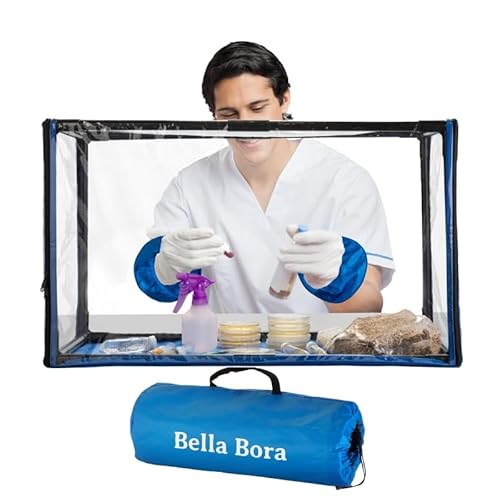
Bella Bora emphasizes visibility and durability, incorporating design updates that improve setup ease and arm flexibility. The unit is scratch-resistant and waterproof, built to last longer than lower-cost options. Notably, it is designed for precise movements during handling, lowering risk when working with sharp tools or delicate cultures. It supports a range of mycology tasks, including agar inoculation, spore syringes, and plant tissue culture, and doubles as a mushroom fruiting chamber. A robust, simpler-to-clean workspace makes it a strong pick for both beginners and experienced hobbyists.
The product’s U.S. design patents underscore its focus on reliable containment and ergonomic use. Its arm ports stay snug without attached gloves, allowing users to work with their own disposable gloves between steps. For growers prioritizing clarity of operation and long-term durability, Bella Bora offers a compelling balance of performance and value.
ACover Large Still Air Box Mushroom

ACover’s large SAB emphasizes a clean, sealed environment with a double side door design to simplify cleaning and access. The 3D PVC plastic construction is highly transparent, enabling easy observation of mushroom growth and facilitating documentation. The double-arm design allows manipulation from multiple angles while maintaining a sterile atmosphere. This model is particularly suitable for operations that require frequent access to inside the box, such as inoculation, transfer, and observation of mycelial development. It supports adding lights or cameras to monitor progress, maximizing control over the cultivation process.
Considerations for this option include the ease of cleaning and the ample interior space that accommodates a range of supplies. The robust build and clear walls help in maintaining consistent moisture and sterile conditions, essential for successful mushroom culture in home settings.
amymark Still Air Box

The amymark SAB is designed with easy folding and pop-up assembly, making it a versatile option for home growers who need a portable solution. The kit typically includes a mushroom tent, a set of lights, extension cords, tubes, and connection components to support a full growing workflow. A large interior allows multiple mushroom bags, offsets space constraints, and reduces clutter when not in use. The kit’s materials emphasize visibility and durability, enabling growers to monitor growth closely from inoculation through pinning and fruiting.
Folding functionality and included accessories make amymark a practical choice for growers seeking an all-in-one setup that’s simple to store and transport. When evaluating SABs for regular use, consider how easily you can reconfigure the space for different mushroom species and setups, as well as how the provided lighting affects growth stages.
Ehaijia Large Still Air Box Mushroom Grow Set

Ehaijia’s SAB kit combines a large grow tent with two mushroom lights and a complete bundle of tubes and connectors to support a robust indoor setup. The dual-spectrum lighting aims to optimize growth from pinning through fruiting by delivering targeted wavelengths. The interior is spacious enough to accommodate multiple grow bags and additional equipment, while the included lighting helps ensure uniform illumination across the entire growing area. This option is well-suited for growers who want an all-in-one solution with lighting, making it easier to transplant and manage different strains indoors.
When choosing a kit like Ehaijia, consider the energy needs and heat output of the lights, especially in small rooms. Also assess whether you want fixed lighting versus future expansion with additional fixtures, and whether the kit’s storage solution matches your available space when not in use.
Buying Guide: Key Purchase Considerations
- Size and interior space: Choose a SAB that matches the number of grow bags you plan to use. A larger interior eases handling and reduces crowding, but requires more space and airflow management.
- Visibility and material: Clear, transparent walls are crucial for observing mycelial growth and performing timely interventions. Durable, waterproof, and scratch-resistant materials prolong the life of the unit.
- Arm ports and glove design: Consider whether gloves are attached or if you’ll wear disposable gloves. Non-attached gloves can reduce contamination risk if you manage hygiene meticulously, but attached gloves offer immediacy.
- Seal and contamination control: A robust seal and minimal air leakage help maintain a stable environment. Double doors or dual side access can improve cleaning and workflow without disturbing the sterile area.
- Portability and setup: Folding or pop-up designs improve storage and transport. Look for set-up manuals and included accessories (lights, hygrometers, tubing) that match your planned workflow.
- Lighting and atmosphere: If the SAB includes lights, ensure they provide appropriate spectrum for mycelial growth and pinning. If not, plan for compatible external lighting options that won’t disrupt the sterile field.
- Durability and durability-to-cost ratio: Higher-quality materials may cost more upfront but offer longer life and fewer replacements, reducing long-term costs for serious hobbyists.
- Cleaning and maintenance: Easy-to-clean interiors, accessible seams, and washable components simplify routine sanitation between runs and reduce contamination risk.
Selecting the right still air box involves aligning your available space, the scale of your growing operation, and your preferred workflow. For beginners, consider a kit with bundled components and lighting to simplify setup. For seasoned hobbyists, prioritize interior space, ease of cleaning, and proven containment features to support frequent culture work and larger bag-based grows. Across the options listed, a balance of visibility, durability, and practical design will help maximize observation accuracy and cultivation success in an at-home environment.