Answer: Oscillating sprinklers provide broad, adjustable coverage for lawns and gardens, with models suited for mid-size to large spaces. This guide highlights five reliable options and explains who each is best for, with clear, decision-friendly comparisons.
| Product | Best For | |
|---|---|---|
| Eden 96213EDAMZ Weighted Essential Oscillating Sprinkler | Medium to large lawns; those needing precise range control | Up to 3,600 sq. ft. |
| EC.TEAK Lawn Sprinkler with 18 Brass Nozzles | Durability-focused users; higher stability in windy areas | Up to 3,600 sq. ft. |
| Melnor 65137AMZ MiniMax Turbo Oscillating Sprinkler | Smaller yards; want a compact design with full-size reach | Up to 4,000 sq. ft. |
| Melnor 65131AMZ MiniMax Turbo Oscillating Sprinkler | Budget-friendly compact option; easy setup | Up to 4,000 sq. ft. |
| Eden 94110 Heavy-Duty Metal Oscillating Sprinkler | Heavy-use or larger lawns; robust metal build | Up to 3,315 sq. ft. |
The following sections present five selected products with concise, buyer-focused details. Each entry notes who benefits most, why it’s chosen, and a practical caveat to watch for indoor/outdoor use, water pressure, or maintenance needs.
Eden 96213EDAMZ Weighted Essential Oscillating Sprinkler
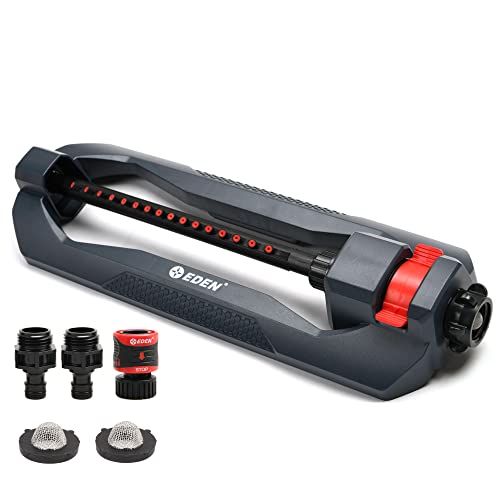
Best for: Homeowners needing even coverage and adjustable range on medium-to-large lawns. This Eden model uses 16 precision nozzles for consistent watering and a sealed turbo drive motor for smooth, quiet operation and longer gear life. The adjustable range controls let you tailor coverage to garden beds or whole-lawns.
Why selected: The 3,600 sq. ft. coverage and turbo-driven design support reliable performance in varied terrains, while stainless filters reduce debris impact. It’s a practical all-around sprinkler for regular irrigation tasks.
Limitation: The setup may require careful hose alignment to ensure uniform distribution across very irregular landscapes.
Lawn Sprinkler With Brass Nozzles By EC.TEAK

Best for: Gardeners seeking durable hardware with many nozzles for broad coverage and stability in windy conditions. This model features 18 brass nozzles for wide, even spread, plus an extra-large base for stability.
Why selected: Brass nozzles typically offer superior wear resistance and even spray patterns, which helps reduce adjustments over time. The adjustable range allows precise targeting.
Limitation: More fittings and assembly steps can be required, and brass components may need occasional maintenance to prevent mineral buildup in hard water.
Melnor MiniMax Turbo Oscillating Sprinkler (4,000 sq. ft.)

Best for: Large lawns that benefit from a compact footprint and simple, four-way adjustments. The MiniMax offers full-size coverage in a space-saving design, with independent width, range, and flow controls.
Why selected: It balances reach with ease of use, ideal for yard builders who want predictable coverage across multiple zones without bulky equipment.
Limitation: The four-way adjustments may require a bit of trial to set just right for irregular borders or widely separated plantings.
Melnor MiniMax Turbo Oscillating Sprinkler (4,000 sq. ft.)

Best for: Budget-conscious buyers who still want robust coverage up to 4,000 sq. ft. with multi-point adjustment. It includes 360° rotating head and separate controls for width, range, and flow.
Why selected: The 360° rotating head and independent controls help direct water where it’s needed, reducing waste and promoting even growth across uneven terrain.
Limitation: The plastic components may be less durable in harsher outdoor environments compared to metal bases.
Melnor XT Turbo Oscillating Sprinkler (4,500 sq. ft.)

Best for: Large yards needing maximum coverage with a sturdy metal base. The XT Turbo design covers up to 4,500 sq. ft. and offers 3-way adjustments for width, range, and flow.
Why selected: This model combines high coverage with practical controls that help tailor watering across expansive lawns, making it suitable for seasonal irrigation plans.
Limitation: Its larger footprint may require more space and careful storage when not in use, and some users may need to verify compatibility with their hose setup.
Buying Guide
Key considerations to choose the right oscillating sprinkler:
- Coverage area: Match sprinkler range to your lawn size. Larger lawns benefit from models rated around 3,600–4,500 sq. ft.
- Adjustability: Look for adjustable width, range, and flow to target beds and open areas without overwatering.
- Sprinkler base and durability: Metal bases and brass nozzles tend to be more durable in harsh conditions; consider climate and debris in your water supply.
- Water pressure and connection: Ensure compatibility with your hose setup and water pressure; some models require stronger pressure for optimal performance.
- Installation and storage: Compact units are easier to store; consider quick-connect bundles for fast setup and removal.
- Maintenance: Debris resistance and easy cleaning help maintain consistent spray patterns over seasons.
Practical tips for best results
- Place sprinklers to avoid runoff, especially on slopes; stagger run times to maximize absorption.
- Adjust spray radius to prevent overspray onto driveways or sidewalks.
- Clean or replace nozzles periodically to maintain even coverage.
FAQ
- What size lawn is best for an oscillating sprinkler?
Oscillating sprinklers are well-suited for medium-to-large lawns; models with up to 4,500 sq. ft. coverage work well for most residential lawns.
- Why would I choose brass nozzles?
Brass nozzles typically offer durability and consistent spray patterns, especially in outdoor conditions with mineral buildup considerations.
- Can oscillating sprinklers be used with multiple zones?
Yes. Some models allow easy width and range adjustments to cover several zones within a single system.
- What maintenance is recommended?
Inspect for clogs, clean nozzles, and check the drive mechanism regularly; rinse debris from the water supply to extend life.
- Are these sprinklers suitable for well water?
Many are designed to handle well water, but dirt-resistant drives help ensure smoother operation; verify local water quality and filter needs.